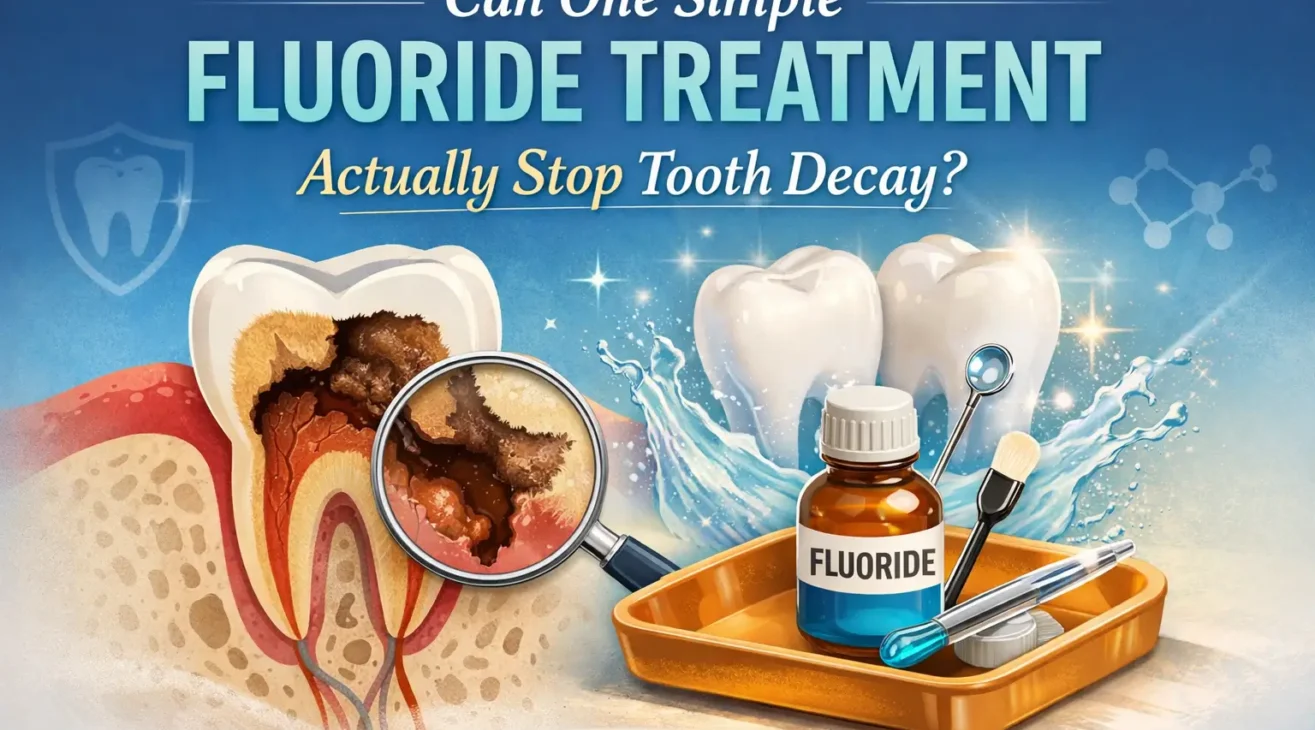
Can One Simple Fluoride Treatment Actually Stop Tooth Decay?
Tooth decay is one of those problems most people assume is inevitable. You brush, you floss (sometimes), you still get a cavity. So when patients hear a dentist say, “A fluoride treatment can help stop this,” the reaction is often skeptical.
Can one simple fluoride treatment actually stop tooth decay?
Or is it just another preventive add-on that sounds good but doesn’t change much?
The honest answer is more nuanced, and more hopeful—than most people realize.
When used correctly and at the right stage, fluoride treatment for tooth decay can do more than just slow damage. In many cases, it can halt early decay, strengthen vulnerable enamel, and prevent small problems from turning into lifelong dental issues. To understand how and when that’s possible, we need to break down what tooth decay really is, how it progresses, and where fluoride fits into the picture.
Table of Contents
What Causes Tooth Decay (And Why It Starts Quietly)
To understand how fluoride works, it helps to understand what causes tooth decay in the first place.
Tooth decay doesn’t start as a hole. It starts as a chemical imbalance.
Your mouth is home to hundreds of bacteria. Some are harmless, some are helpful, and some feed on sugars and carbohydrates left behind after eating. When these bacteria digest sugars, they produce acids. Those acids pull minerals, mainly calcium and phosphate, out of your enamel. This process is called demineralization.
Under normal conditions, saliva helps repair this damage by redepositing minerals back into the enamel. That repair process is known as remineralization.
Tooth decay begins when demineralization happens faster than remineralization.
Common contributors include:
- Frequent snacking or sipping sugary or acidic drinks
- Poor or inconsistent oral hygiene
- Dry mouth (low saliva flow)
- Deep grooves in teeth, especially molars
- Gum recession exposing vulnerable root surfaces
Early on, there’s no pain. No hole. No dramatic symptoms. This is why decay often goes unnoticed until it becomes more complicated to treat.
The Stages of Tooth Decay: Where Fluoride Makes the Biggest Difference
Understanding the stages of tooth decay is critical, because fluoride is most effective during specific phases.
1. Tooth Decay Beginning Stages (White Spot Lesions)
This is the earliest and most reversible stage.
- Enamel starts losing minerals
- Chalky white spots may appear on the tooth
- No cavity has formed yet
At this stage, fluoride treatment for tooth decay can be remarkably effective. Fluoride strengthens enamel and helps replace lost minerals, sometimes completely reversing the damage.
2. Enamel Decay
If the imbalance continues:
- Acid damage penetrates deeper into enamel
- A small cavity may form
- Sensitivity to sweets or cold may begin
Fluoride can still help slow progression, but structural damage may already be present.
3. Dentin Decay
Once decay reaches dentin:
- The tooth becomes more sensitive
- Decay spreads faster
- Restorative treatment is usually required
Fluoride still plays a protective role, but it cannot rebuild lost tooth structure.
4. Pulp Involvement
At this stage:
- Pain becomes significant
- Infection may develop
- Root canal or extraction may be necessary
Fluoride’s role here is preventive for other teeth—not curative for the damaged one.
Why Tooth Decay in Molars Is So Common
Tooth decay in molars is especially prevalent, even among people who brush regularly.
Molars have:
- Deep pits and fissures that trap food
- Hard-to-reach surfaces
- Higher exposure to chewing forces
These grooves are ideal hiding places for bacteria. Fluoride strengthens enamel, but it doesn’t physically seal deep grooves. This is why dentists often recommend fluoride treatments alongside sealants for molars, especially in children and cavity-prone adults.
When fluoride is applied early and consistently, it makes molar enamel more resistant to acid attacks, reducing the risk of decay taking hold in those vulnerable areas.
Tooth Decay at the Gum Line: A Different Challenge
Tooth decay at the gum line is becoming more common, particularly in adults.
As gums recede due to age, brushing habits, or gum disease, the tooth root becomes exposed. Root surfaces are not covered by enamel—they’re made of dentin, which is softer and more prone to decay.
Fluoride is especially important here because:
- Dentin demineralizes faster than enamel
- Root decay progresses quickly
- Sensitivity often limits effective brushing
Professional fluoride treatments and prescription fluoride toothpaste can significantly reduce decay risk along the gum line by strengthening dentin and reducing bacterial activity.
How Fluoride Treatment for Tooth Decay Actually Works
Fluoride isn’t magic—but it is chemically powerful.
Here’s what it does:
1. Strengthens Enamel
Fluoride integrates into the tooth structure to form fluorapatite, which is more resistant to acid than natural enamel.
2. Reverses Early Damage
In early decay stages, fluoride promotes remineralization, allowing teeth to recover lost minerals before cavities form.
3. Inhibits Bacterial Activity
Fluoride interferes with the enzymes bacteria use to produce acid, reducing their ability to cause damage.
4. Provides Ongoing Protection
Topical fluoride leaves a reservoir on the tooth surface that continues working between brushing sessions.
This is why fluoride treatment for tooth decay is considered both preventive and, in early cases, therapeutic.
Evidence and Data: Does Fluoride Actually Reduce Cavities?
Decades of research consistently support fluoride’s effectiveness.
- Community water fluoridation reduces cavities in adults by approximately 25%
- Professional topical fluoride treatments reduce decay risk in children and adults by 20–40%
- High-risk patients using prescription fluoride toothpaste experience significantly fewer new cavities
These benefits are strongest when fluoride is part of a broader prevention strategy, not a standalone solution.
Tooth Decay Treatments: Where Fluoride Fits In
When people ask about tooth decay treatments, they often assume drilling and filling are the only options. In reality, treatment depends on severity.
Non-Invasive Treatments
- Fluoride varnish or gel
- Prescription fluoride toothpaste
- Dietary changes
- Improved oral hygiene
Best for early-stage decay.
Minimally Invasive Treatments
- Resin infiltration
- Sealants
- Small fillings
Used when enamel damage is present but limited.
Restorative Treatments
- Fillings
- Crowns
- Root canals
Required when decay progresses beyond enamel.
Fluoride doesn’t replace restorative dentistry, but it can delay or prevent the need for it.
How to Get Rid of Tooth Decay (Without Overpromising)
A common question is how to get rid of tooth decay naturally or without drilling.
The truthful answer:
- Early decay can sometimes be reversed
- Advanced decay cannot be undone
Fluoride can stop early decay and strengthen weak enamel, but once a cavity forms, the damaged structure must be restored.
Be wary of claims that any product can “heal” deep cavities without professional care.
Can You Reverse Tooth Decay?
The idea of reverse tooth decay is not marketing hype, but it applies only to early stages.
Reversal is possible when:
- Decay is limited to enamel
- No cavitation has occurred
- Fluoride exposure is consistent
- Oral hygiene improves
This is why early detection and preventive fluoride therapy are so important.
How to Prevent Tooth Decay Long Term
Prevention is where fluoride shines brightest.
Practical strategies include:
- Brush twice daily with fluoride toothpaste
- Use floss or interdental cleaners daily
- Limit frequent sugar and acid exposure
- Stay hydrated to support saliva flow
- Get professional fluoride treatments if you’re high risk
- Address dry mouth or gum recession early
For many people, fluoride is the difference between managing risk and constantly chasing cavities.
Common Misconceptions About Fluoride
- “Fluoride is only for kids.”
Adults benefit just as much—sometimes more. - “If I brush well, I don’t need fluoride.”
Brushing removes plaque; fluoride strengthens enamel. - “Fluoride just masks problems.”
Properly used, it addresses the chemical process that causes decay.
FAQs: Fluoride Treatment and Tooth Decay
1. Can fluoride treatment really stop a cavity from forming?
Yes, if the decay is caught early. Fluoride can stop and even reverse tooth decay beginning stages before a cavity forms.
2. How often should adults get fluoride treatment?
It depends on risk factors. Many adults benefit from professional fluoride applications every 3–6 months, especially those with gum recession or frequent cavities.
3. Is fluoride effective for tooth decay in molars?
Yes. While molars are harder to protect due to deep grooves, fluoride significantly strengthens enamel and reduces acid damage.
4. Can fluoride help with tooth decay at the gum line?
Absolutely. Fluoride is one of the most effective defenses against root decay, especially when paired with proper brushing techniques and regular dental visits.
Final Thoughts: Is One Simple Fluoride Treatment Enough?
Fluoride is not a miracle cure, but it is one of the most reliable, evidence-based tools dentistry has.
When used early, consistently, and appropriately, fluoride treatment for tooth decay can stop early damage, reduce future risk, and preserve natural teeth longer. For many patients, it’s the difference between prevention and lifelong repair.
The key is timing, consistency, and understanding that fluoride works best as part of a comprehensive oral health strategy, not as a last-minute fix.
In preventive dentistry, simple tools used early often have the biggest impact. Fluoride is a perfect example of that principle in action.